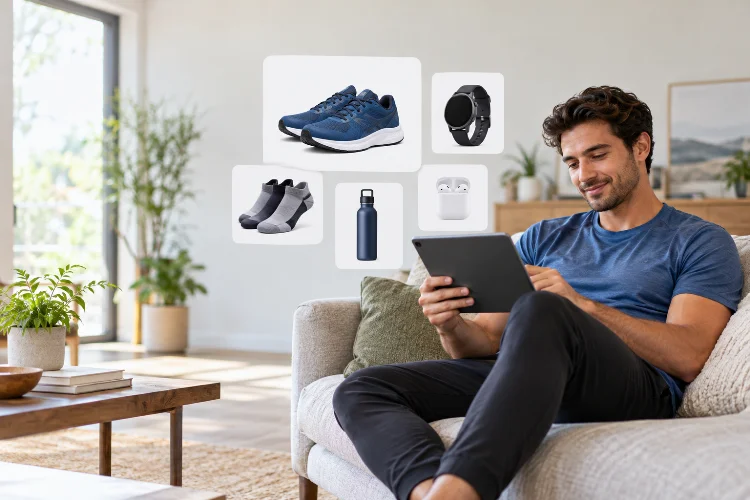
Have you ever searched for a pair of running shoes online, only to find your shopping feed suddenly filled with athletic socks, fitness watches, and workout accessories?
Or maybe you’ve purchased a smartphone, and your favorite shopping platform immediately starts suggesting phone cases, wireless chargers, and screen protectors.
It almost feels like the website knows exactly what you’re thinking.
Well, not quite. But there’s some pretty sophisticated technology working behind those seemingly perfect suggestions.
Welcome to the world of e-commerce recommendation algorithms for shoppers, where artificial intelligence, machine learning, and behavioral data work together to predict which products might interest you.
These systems have become an important part of modern online shopping, helping consumers discover products while giving retailers opportunities to increase sales.
However, recommendations aren’t always as objective or helpful as they appear.
Some suggestions genuinely match your needs, while others may prioritize popular products, promotional campaigns, or additional purchases.
Understanding how these algorithms operate can help you shop more confidently, protect your personal information, and recognize when a recommendation is worth considering.
Let’s explore how it all works.
1. What Are E-Commerce Recommendation Algorithms?
E-commerce recommendation algorithms are automated systems that analyze information to suggest products a shopper might want to explore or purchase.
Instead of displaying the same products to everyone, many online stores use these systems to create more relevant shopping experiences based on individual behavior, product characteristics, or broader purchasing patterns.
Think of them as digital shopping assistants that continuously study what customers seem interested in.
How Product Recommendations Became Common in Online Retail
Before personalized shopping technology became widespread, online retailers typically relied on relatively simple product displays.
Customers might see bestselling products, newly released items, or products manually selected by store managers.
These approaches still exist, but modern recommendation engines can evaluate much larger collections of information.
One influential development was Amazon’s item-to-item collaborative filtering system, described in a 2003 research paper by Greg Linden, Brent Smith, and Jeremy York.
Rather than simply finding customers with similar preferences, this approach identified relationships between products based on purchasing behavior.
For example, if many customers purchased a digital camera and later bought a particular memory card, the system could recognize that relationship and suggest the accessory to future camera buyers.
Amazon Science’s historical overview explains how this method helped make large-scale product personalization practical.
Recommendations Are Predictions, Not Certainties
It’s important to understand that an algorithm doesn’t actually know what you want.
Instead, it estimates which products are likely to interest you based on available signals.
If you frequently browse camping equipment, the system may predict that you’ll also appreciate hiking backpacks or portable cooking gear.
However, that prediction could be completely wrong if you were only researching equipment for a friend.
The algorithm works with patterns and probabilities rather than an accurate understanding of your personal intentions.
2. How Shopping Platforms Collect and Interpret Your Behavior
One of the most interesting things about recommendation technology is how much it can learn from relatively ordinary shopping activities.
Even simple actions, such as opening a product page or adding something to your cart, can provide useful information.
Browsing History and Product Interactions
When you browse an online store, the platform may record which products you view, how you interact with pages, and which categories attract your attention.
Depending on the platform’s design and privacy settings, this information can influence future recommendations.
For example, imagine spending several minutes comparing four different coffee machines.
The system might conclude that you’re interested in home coffee equipment and start displaying related products.
But browsing history isn’t always a reliable indicator of purchase intention.
You might be comparing products for a research project, helping someone else shop, or simply satisfying your curiosity.
Purchase History and Shopping Preferences
Completed purchases often provide stronger evidence of your shopping interests.
If you regularly buy skincare products, a recommendation system might suggest related moisturizers, cleansers, or replacement products.
Purchase history can also reveal recurring needs.
Someone buying pet food every month, for example, may appreciate timely suggestions when another purchase is likely to be needed.
Google Cloud’s retail recommendation documentation includes models designed for functions such as “Buy it Again,” “Frequently Bought Together,” and “Recommended for You.”
These illustrate how different shopping situations require different recommendation strategies.
Explicit and Implicit Feedback
Recommendation systems can learn from two major types of feedback.
Explicit feedback includes actions where customers intentionally express an opinion, such as providing star ratings, submitting reviews, or marking products as favorites.
Implicit feedback comes from behavior that indirectly suggests interest, including clicks, purchases, and browsing activity.
Both are useful, but neither is perfect.
A five-star review may indicate genuine satisfaction, while a product click may simply reflect curiosity.
Advanced systems attempt to combine these signals rather than treating every interaction as equally meaningful.
Contextual Shopping Signals
Recommendations may also depend on the context of your shopping session.
A retailer might consider the time of year, device type, current product category, or selected delivery region.
For example, a store may promote umbrellas during rainy weather or highlight holiday decorations during festive periods.
These suggestions aren’t necessarily personalized to your identity.
Sometimes they’re generated from general market conditions or the page you’re currently viewing.
3. The Main Types of Product Recommendation Algorithms
Not every recommendation engine works in the same way.
Different algorithms use different methods to identify products that may be relevant, and many retailers combine several approaches.
Collaborative Filtering: Learning From Similar Shopping Patterns
Collaborative filtering is one of the best-known recommendation techniques.
It identifies relationships between users and products by analyzing patterns across many interactions.
Imagine that you and another shopper have purchased several similar books, headphones, and computer accessories.
If that shopper buys a product you haven’t considered, the system might recommend it to you.
This doesn’t necessarily mean the retailer believes you’re identical customers.
It simply recognizes that your purchasing patterns share similarities.
According to Google’s Machine Learning documentation, collaborative filtering can uncover products outside a shopper’s usual categories because it learns relationships from interactions rather than relying entirely on predefined product attributes.
However, this method can struggle when new products or shoppers have little interaction history.
This challenge is often called the cold-start problem.
Content-Based Filtering: Matching Product Characteristics
Content-based filtering takes a different approach.
Instead of primarily analyzing similarities across customers, it examines product attributes and what the shopper previously liked.
Imagine you’ve been viewing lightweight hiking shoes with waterproof materials and flexible soles.
A content-based system might identify other shoes with similar characteristics and recommend them.
This approach works particularly well when products have detailed descriptions and consistent attributes.
However, it can also create repetitive suggestions.
If you keep browsing black sneakers, the algorithm might continue recommending black sneakers even when you’d appreciate something different.
Hybrid Recommendation Systems
Many sophisticated platforms use hybrid systems that combine collaborative and content-based approaches.
For instance, a retailer might consider both the technical specifications of a product and the purchasing behavior of customers with related interests.
This creates more opportunities to generate relevant suggestions.
Hybrid models can also help address weaknesses in individual methods.
When a new product has limited sales history, its specifications may still help the system identify potential customers.
When a shopper’s personal history is limited, general popularity and contextual information can provide useful starting points.
AI and Deep Learning Recommendations
More advanced recommendation engines use neural networks and other machine learning techniques to identify complex relationships.
These systems can analyze large datasets containing product descriptions, customer interactions, visual characteristics, and contextual information.
For example, an AI model might recognize that shoppers interested in minimalist home interiors often explore furniture with specific shapes, materials, and colors.
Rather than relying exclusively on manually created rules, the model learns associations from historical information.
Still, more complicated technology doesn’t automatically produce better suggestions.
Accuracy depends on training data, system design, and how effectively the retailer evaluates its results.
4. Why Certain Products Appear in Your Shopping Feed
Have you ever wondered why one product appears at the top of your recommendations while another remains almost invisible?
The answer often involves a process that ranks products according to predicted relevance and business rules.
Candidate Selection and Ranking
Modern recommendation systems commonly operate through several stages.
According to Google’s recommendation system architecture documentation, a typical design includes candidate generation, scoring, and re-ranking.
First, the system identifies a manageable collection of potentially relevant products from a much larger catalog.
Next, it scores those products based on their estimated relevance or another optimization objective.
Finally, additional rules can adjust the ordering to consider diversity, freshness, or other requirements.
Imagine an online store containing 200,000 products.
The recommendation system might initially select a few hundred candidates before narrowing the display to ten items.
This makes the process considerably more efficient than evaluating every possible product in detail each time a page loads.
Different Recommendation Sections Have Different Purposes
Not every suggestion is intended to accomplish the same thing.
A “Similar Items” section typically helps you discover alternatives to the product you’re viewing.
A “Frequently Bought Together” section suggests complementary products that customers commonly purchase in combination.
Meanwhile, a personalized homepage may emphasize products associated with your previous interactions.
These distinctions matter because a suggestion that’s appropriate in one context may be irrelevant in another.
Someone comparing laptops probably needs alternative models, while someone who just purchased a laptop might find compatible accessories more useful.
Recommendations and Sponsored Products Are Different
Another important distinction involves advertisements.
Some product placements are advertisements funded by sellers, while others are generated through recommendation models based on predicted relevance.
Retail platforms may display both types in nearby sections, making them easy to confuse.
Sponsored results should be identified according to applicable advertising disclosure rules.
A product appearing prominently doesn’t automatically mean it’s the best choice, the highest-rated option, or the cheapest available.
5. How Recommendation Engines Improve the Shopping Experience
Despite their limitations, recommendation systems offer several genuine advantages.
When designed properly, they can reduce the effort required to search through enormous online product catalogs.
Faster Product Discovery
Imagine shopping for a home office chair on a marketplace containing thousands of listings.
Without recommendations, you might spend hours exploring products that don’t match your needs.
A well-designed system can help narrow the options by suggesting chairs with features related to your browsing activity.
This doesn’t eliminate the need for comparison, but it can make the process more manageable.
Discovering Products You Didn’t Know Existed
Sometimes the best recommendation introduces something completely unexpected.
You might be shopping for a beginner’s camera and discover a compact tripod that solves a problem you hadn’t considered.
Recommendation systems can identify connections between products that aren’t immediately obvious.
This is particularly useful for specialized hobbies, technical equipment, and unfamiliar product categories.
More Relevant Shopping Experiences
Personalized suggestions can reduce irrelevant product displays.
Someone interested in gardening equipment may prefer seeing planting tools and irrigation accessories rather than unrelated electronics.
However, relevance depends on the accuracy of the underlying data.
If your shopping history contains unusual one-time purchases, the reccomendations may temporarily become less useful.
Helping With Repeat Purchases
Recommendation systems can also simplify recurring shopping tasks.
Products such as household cleaning supplies, personal care items, and pet accessories often need regular replacement.
A retailer may recognize recurring purchasing patterns and suggest products when they might be needed again.
These features can be convenient, provided they don’t encourage unnecessary purchases or unwanted subscriptions.
6. The Hidden Risks of Personalized Shopping Recommendations
Recommendation technology isn’t automatically beneficial simply because it makes shopping easier.
The same systems that help you discover products can also influence your decisions in ways that deserve closer attention.
Popularity Bias and Limited Product Diversity
One major challenge is popularity bias.
This occurs when recommendation systems disproportionately favor products that already receive substantial attention.
A 2024 academic survey published in User Modeling and User-Adapted Interaction reviewed 123 research papers addressing popularity bias in recommender systems.
The researchers found that popularity-focused recommendations can limit exposure to lesser-known items and reinforce existing patterns.
For shoppers, that means useful alternatives may remain hidden even when they’re affordable or better suited to individual needs.
Popular products aren’t necessarily poor choices, but popularity shouldn’t be confused with quality.
The Filter Bubble Effect
Personalization can also make shopping experiences unnecessarily narrow.
Imagine browsing luxury watches for several days.
The algorithm might repeatedly show expensive watches and related premium accessories, even after your interests change.
Over time, this creates a kind of shopping filter bubble in which previously observed interests dominate future suggestions.
Trying different search terms or exploring categories directly can help uncover alternatives that personalized feeds overlook.
Privacy and Behavioral Tracking
Recommendation engines often rely on behavioral information, raising questions about how that data is collected and used.
The amount of information varies between retailers, and not every recommendation requires extensive personal tracking.
Some systems use product relationships and current-session context without needing a detailed customer profile.
Nevertheless, shoppers should understand the difference between information required for essential services and optional tracking used for personalization or advertising.
Privacy policies and account settings can help clarify available controls.
Impulse Purchases and Manipulative Design
Have you ever intended to purchase one product but ended up buying several additional items?
Recommendation panels can contribute to this behavior by making complementary products look attractive and convenient.
There is nothing inherently deceptive about suggesting a phone case alongside a smartphone.
Problems arise when recommendations are combined with misleading urgency, disguised advertising, or confusing purchasing options.
The US Federal Trade Commission’s Bringing Dark Patterns to Light report examines how certain digital interface designs can manipulate consumer decisions.
These practices demonstrate why convenience and consumer protection need to work together.
Recommendations Don’t Guarantee Value
A highly ranked product isn’t necessarily the most affordable or reliable option.
Some systems optimize for engagement, conversion probability, or revenue rather than customer satisfaction alone.
Google Cloud’s recommendation model documentation shows that different recommendation models can use objectives such as click-through rate, conversion rate, or revenue per session.
Understanding these objectives helps explain why a retailer might recommend a product that isn’t automatically your best choice.
7. How Shoppers Can Take Control of Recommendation Algorithms
The good news is that you don’t need advanced technical knowledge to shop more independently.
A few practical habits can help you benefit from personalization without allowing automated suggestions to dominate your purchasing decisions.
Use Recommendations as Discovery Tools
Treat recommended products as starting points rather than final purchasing decisions.
If a platform suggests a pair of wireless headphones, examine the product’s specifications, independent reviews, warranty, and competing alternatives.
Consider whether the item meets your actual needs instead of assuming that algorithmic relevance equals product quality.
The recommendation may be useful, but the final evaluation should remain yours.
Manage Your Shopping History and Preferences
Some platforms provide options to remove recently viewed products, adjust recommendation preferences, or mark particular suggestions as irrelevant.
These features can help when your shopping history no longer reflects your interests.
For example, if you spent a weekend researching baby products for a relative, you might not want those products influencing your recommendations for months.
Review your account settings to see which controls are actually supported.
Clearing browsing history doesn’t necessarily delete every piece of account information or prevent future tracking, so privacy settings should be checked seperately.
Compare Products Outside Your Personalized Feed
One effective strategy is to search directly for product specifications instead of relying entirely on suggested items.
If you’re buying a laptop, compare processor performance, memory, battery life, warranty terms, and total cost.
Look beyond the products displayed on your homepage.
Different marketplaces, independent reviews, and manufacturer specifications can reveal alternatives that a single recommendation engine might overlook.
The FTC’s online shopping guidance also encourages consumers to compare sellers and review information from multiple sources.
Set Shopping Budgets Before Browsing
Recommendation systems are particularly effective at presenting products when your interest is already high.
A $15 accessory may seem insignificant after purchasing a $200 item.
But buying several unnecessary accessories can quickly increase the total cost.
For example, adding three suggested products costing $18, $24, and $29 increases a purchase by $71.
Creating a clear budget before shopping helps distinguish useful recommendations from impulse purchases.
Review Privacy and Personalization Controls
Privacy options vary significantly between platforms and regions.
Some retailers allow users to limit personalized advertising, modify shopping preferences, or manage certain browsing records.
Within the European Union, Article 27 of the Digital Services Act requires covered online platforms using recommender systems to explain their main recommendation parameters and available ways to influence them.
Article 38 also requires designated very large online platforms and search engines to offer at least one recommendation option not based on profiling.
These requirements don’t mean every online retailer worldwide offers identical controls.
Still, they reflect growing attention to recommendation transparency and consumer choice.
Keep Your Shopping Preferences Flexible
Finally, remember that your interests can change.
A recommendation system may continue relying on past behavior even when your priorities shift.
If your budget, lifestyle, or product requirements change, search intentionally for options outside your usual categories.
Occassionally exploring unfamiliar brands or product types can expose you to alternatives that automated suggestions might overlook.
The goal isn’t to avoid recommendation technology completely.
It’s to use the technology without surrendering control over your purchasing decisions.
E-commerce recommendation algorithms have transformed online shopping by making product discovery faster, more personalized, and increasingly data-driven.
Through collaborative filtering, product similarity analysis, and advanced machine learning, these systems predict which items might interest individual shoppers.
However, their recommendations aren’t always neutral. Popularity bias, advertising priorities, limited product diversity, and privacy concerns can influence what appears on your screen.
Understanding these limitations allows you to enjoy the convenience of personalized shopping while making more independent decisions.
Instead of automatically trusting every suggested product, compare alternatives, review your privacy settings, and focus on genuine value.
Ready to become a smarter online shopper? Start paying attention to why products appear in your recommendations, explore options beyond your personalized feed, and make purchasing decisions based on your needs – not just an algorithm’s predictions.