Imagine buying a new laptop for $950, feeling pretty satisfied with the deal, and then discovering that the same model was available for $780 just two weeks earlier.
Ouch. That’s the kind of shopping regret nobody enjoys.
The problem with online shopping isn’t necessarily finding discounts. It’s figuring out whether those discounts are actually worth taking advantage of.
Retail prices move constantly. Products become cheaper during promotions, rise when inventory tightens, and sometimes fluctuate without any obvious explanation.
That’s why using historical price data to optimize online buying decisions has become such a valuable strategy for modern consumers.
Instead of guessing whether today’s offer is attractive, shoppers can study previous prices, identify recurring patterns, and establish realistic expectations before spending money.
And no, you don’t need to be a professional data analyst to make this work.
With a few simple calculations, the right tracking tools, and a little patience, you can turn ordinary price observations into useful shopping insights.
Let’s explore how historical pricing information can help you recognize genuine bargains, avoid misleading promotions, and make smarter purchasing choices.
1. Understanding Historical Price Data and Why It Matters
Historical price data is essentially a record of how much a product has cost over a particular period.
These records might cover several days, months, or even years, depending on the product and tracking service.
For online shoppers, that information provides something promotional banners rarely offer: context.
What Historical Pricing Reveals
Suppose you’re researching a pair of wireless headphones currently advertised for $180.
The retailer claims they’re 25% off, making the offer appear attractive.
But when you check their price history, you discover something interesting. The headphones have regularly sold between $165 and $185 during the previous three months.
Suddenly, that $180 price doesn’t look particularly special.
Historical pricing helps you understand whether today’s offer represents a meaningful saving or simply another point within the product’s normal trading range.
It can also highlight unusually expensive periods, recurring sales, and gradual price reductions following new product releases.
Why Current Prices Don’t Tell the Whole Story
A product’s current price represents only one moment in its pricing history.
Without additional information, there’s no reliable way to determine whether it is relatively cheap, expensive, or completely ordinary.
Consider a hypothetical television with these recorded prices:
| Month | Historical Price |
|---|---|
| January | $850 |
| February | $820 |
| March | $790 |
| April | $830 |
| May | $760 |
| June | $805 |
If the television currently costs $775, that price looks competitive compared with most observations.
However, the record also shows that the product previously reached $760.
You now have a reasonable reference point for deciding whether purchasing immediately makes sense or whether waiting could be worthwhile.
The important thing is remembering that historical prices describe what happened, not what will definately happen again.
2. Learning to Analyze Price History Charts Like a Smart Shopper
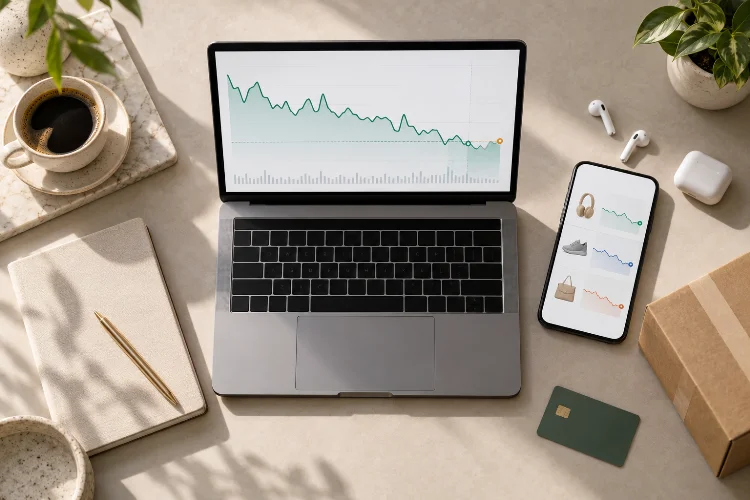
Price history charts are among the most useful tools for understanding ecommerce pricing trends.
They transform dozens or hundreds of recorded prices into a visual timeline, making unusual movements and repeating patterns easier to recognize.
However, simply looking for the lowest number isn’t enough.
Understand the Average, Median, and Lowest Price
Three measurements are particularly useful when evaluating past prices.
The average price represents the total of recorded prices divided by the number of observations. The median is the middle value when prices are sorted, while the historical low identifies the smallest recorded price.
Imagine a product has five equally weighted price observations: $150, $155, $160, $165, and $235.
Its average price is $173, but its median is $160.
The unusually high $235 observation pushes the average upward, potentially making future discounts look more impressive than they really are.
In situations like this, the median may provide a better indication of the product’s typical price.
If the current offer is $145, it represents approximately 9.4% below that historical median.
Distinguish Genuine Discounts From Temporary Price Spikes
One common mistake is comparing today’s offer against the highest recorded price.
That can produce a misleading impression of savings.
Suppose a coffee machine normally costs around $120 but briefly increases to $170. A later promotion offering it for $115 might be described as a huge discount.
Compared with its typical historical price, however, the actual saving is relatively modest.
This is why smart shoppers should examine the overall distribution of prices rather than relying exclusively on historical highs.
Look for the levels at which a product spends most of its time.
Examine Different Time Windows
A 30-day chart helps identify recent price movements, but it may miss important seasonal patterns.
A 90-day view can provide a broader comparison, especially for products affected by frequent promotional campaigns.
For expensive electronics, reviewing six to twelve months may reveal additional price cycles and product-generation effects.
No single observation period works perfectly for everything.
Products that launch recently naturally have shorter histories, while discontinued items may behave differently from those still being actively manufactured.
Also consider how frequently prices were recorded. Missing days or irregular observations can distort averages and make short-lived discounts difficult to identify.
3. Recognizing Seasonal Patterns and Recurring Discount Cycles
One of the most valuable applications of historical pricing is identifying when products have previously become cheaper.
Although future prices remain uncertain, recurring promotions and product lifecycle patterns can reveal periods worth watching.
The objective is to understand tendencies rather than predict exact prices.
Analyze Major Shopping Events
Black Friday, Cyber Monday, Prime Day, and other large retail campaigns frequently generate substantial promotional activity.
However, a major sales event doesn’t automatically mean every product reaches its lowest annual price.
Imagine monitoring a gaming monitor over an entire year.
Its price might fall from $320 to $270 during a spring promotion, rise to $310 during summer, and then appear at $285 during Black Friday.
The Black Friday offer might look impressive compared with the retailer’s advertised reference price, but historical records show an earlier opportunity was better.
This is where price history becomes especially useful.
Rather than assuming a particular shopping event guarantees the strongest deals, evaluate each offer against its previous selling range.
Watch Product Replacement Cycles
New product launches can influence older models’ prices.
When a manufacturer introduces an updated smartphone, laptop, or camera, some retailers discount previous-generation inventory to free warehouse space.
For shoppers who don’t need the newest specifications, these transitions can offer attractive value.
However, price reductions aren’t guaranteed.
Older models sometimes become more expensive as stock disappears, particularly when demand remains strong or replacement products receive mixed reviews.
Compare the older product’s features, warranty support, and available inventory before deciding whether to purchase.
Identify Repeating Price Movements
Some products experience relatively predictable promotional activity.
For example, certain household appliances may recieve discounts during retailer campaigns, while seasonal clothing often becomes cheaper near the end of its primary selling period.
Look for recurring dips across comparable months or events in multiple years.
If a product repeatedly drops into a similar price range, that range may be useful when establishing a target.
Still, remember that inflation, supplier changes, currency fluctuations, and demand shifts can disrupt old patterns.
Historical trends are decision-support tools, not promises about the future.
4. Using Historical Statistics to Establish Better Buying Targets
Once you understand a product’s previous prices, the next step is turning that information into an actual purchasing decision.
This involves defining a price that represents good value before promotional messages influence your expectations.
It’s a simple technique, but it can significantly reduce impulse buying.
Calculate Historical Discounts Correctly
A useful calculation compares the current offer with a reasonable historical benchmark.
Historical Discount (%) = (Historical Reference Price − Current Price) ÷ Historical Reference Price × 100
Suppose a laptop’s historical median is $1,000, and a retailer currently offers it for $850.
The calculation becomes:
($1,000 − $850) ÷ $1,000 × 100 = 15%
That suggests the laptop is currently available 15% below its historical median.
This percentage can be more informative than a retailer’s advertised discount because the benchmark comes from observed selling prices.
However, your calculation is only as reliable as the data behind it.
Create Realistic Price Thresholds
A useful approach is establishing several purchasing thresholds based on historical observations.
Imagine you’ve monitored a tablet with a typical price near $500.
Your personal decision framework might look like this:
| Price Category | Target Price | Recommended Action |
|---|---|---|
| Typical Price | $500 | Continue comparing |
| Moderate Discount | $460 | Monitor more closely |
| Attractive Discount | $425 | Consider purchasing |
| Exceptional Discount | $390 | Buy if all requirements are met |
These figures are hypothetical, not universal discount standards.
What matters is defining thresholds before encountering an eye-catching promotion.
Price targets should also reflect your budget, product urgency, and confidence in the retailer.
Estimate Whether Waiting Is Worthwhile
Historical records can help you think about the potential value of waiting.
Suppose a product currently costs $600, and your research suggests it sometimes falls to $540.
Waiting could save $60 if that lower price returns before your deadline.
But there’s also a possibility that the product remains expensive, sells out, or becomes unavailable in your preferred configuration.
The decision should balance potential savings against these uncertainties.
For something essential to your daily work, a modest immediate discount may be preferable to weeks of uncertainty.
For a nonessential purchase, patience often has fewer practical disadvantages.
5. Using Price Tracking Tools to Turn Research Into Action
Manually collecting pricing observations is possible, but it becomes inconvenient when monitoring several products simultaneously.
Automated tracking platforms can simplify the process by collecting historical records and notifying users when specified conditions are met.
Different services provide different levels of marketplace coverage and analytical detail.
Keepa for Amazon Price History
Keepa is a widely used service for analyzing Amazon product prices.
It provides historical pricing charts and price-drop alerts that help shoppers examine changes over time.
For example, you might discover that a particular pair of headphones regularly fluctuates between $110 and $150.
Rather than purchasing at $145, you could set a tracking threshold around $115.
If the price reaches your target, you can evaluate the offer without continuously checking the listing.
Keepa’s records can also help distinguish price movements across different Amazon offer types, although you should verify exactly which series you’re viewing.
Camelcamelcamel for Price Alerts
Camelcamelcamel offers Amazon price tracking, historical charts, and notifications based on selected price thresholds.
Its historical graphs can include high, low, and average values for supported pricing categories.
This makes it useful for shoppers who prefer a relatively straightforward approach.
For example, someone planning to purchase a coffee grinder could examine its previous price range, establish a target, and wait for an alert.
One important detail is that a tracked price may change before you complete your purchase.
Always confirm the live listing and checkout total rather than assuming the alert reflects an offer that’s still available.
Google Shopping Price Insights
Google provides price insights and tracking tools in supported locations.
According to Google’s official price insights documentation, US shoppers can review whether certain product prices are low, typical, or high relative to historical information.
Its assessment draws on seller pricing information across the web.
Google’s price tracking feature is available in selected countries, including the United States, Canada, Australia, Japan, and India, although availability can vary by device and feature.
These tools can be especially helpful when comparing offers from different retailers.
Shoppers elsewhere may need region-specific marketplace trackers or local comparison services.
Combine Tools Without Overcomplicating Shopping
More tools don’t automatically mean better decisions.
Using one reliable historical tracker alongside a separate retailer comparison method may be sufficient for most purchases.
Keep product variations, currency differences, and seller conditions seperate when comparing records.
It’s also worth reviewing browser-extension permissions before installing any shopping software.
Your objective is to obtain useful information with minimal effort, not create an exhausting monitoring routine.
6. Detecting Misleading Discounts Through Historical Comparisons
Historical pricing isn’t just about finding low prices.
It can also help identify promotional claims that deserve closer inspection.
Online retailers frequently use reference prices, countdown timers, and limited-time messaging to make their offers feel unusually attractive.
Some promotions are legitimate, while others may provide a distorted impression of value.
Understand Reference Price Manipulation
Imagine a retailer selling a vacuum cleaner for $180 over several months.
Shortly before a promotional event, its listed price increases to $250.
The retailer then advertises a limited-time offer of $175.
Compared with the higher reference price, the discount looks substantial. Compared with the product’s typical historical price, the saving is only $5.
This illustrates why advertised percentages shouldn’t be accepted without supporting evidence.
A more useful comparison is the current selling price against a representative history of actual offers.
What Consumer Protection Research Shows
Misleading price promotions are a documented issue.
A European Commission investigation published in March 2026 examined pricing practices during major online shopping events.
Among 314 online traders screened, 30% incorrectly referenced discounts.
The findings demonstrate why independent price history can be useful when evaluating promotional claims.
However, these results concern the traders examined in the investigation and shouldn’t be interpreted as the proportion of all retailers worldwide engaging in misleading practices.
Within the European Union, price-reduction announcements generally must use the lowest price applied during the previous 30 days as their reference, subject to applicable exceptions.
Rules and consumer protections can differ significantly between markets.
Compare Total Purchase Costs
Even a genuine product discount may lose its appeal after additional charges.
Consider an item offered by two stores.
Store A lists it for $240 with $25 shipping, while Store B charges $250 with free delivery.
Assuming identical taxes and other conditions, Store B provides the lower total cost.
Historical comparisons should therefore account for unavoidable fees whenever possible.
The Federal Trade Commission recommends checking total costs, product descriptions, return conditions, and seller reliability when shopping online.
This also means that price tracking should focus on exact product models.
A refurbished laptop, older model, or product with limited warranty coverage shouldn’t automatically be compared with a brand-new equivalent.
7. Building a Practical Data-Driven Shopping Routine
The biggest advantage of historical pricing comes from using it consistently.
You don’t need complicated spreadsheets or advanced statistical software to create a useful purchasing routine.
A few organized habits can make your shopping decisions noticeably more deliberate.
Maintain a Personal Price History Watchlist
Start with products you’re genuinely considering purchasing.
Record their exact names, model numbers, current prices, historical median prices, lowest observed prices, and your preferred purchase targets.
You can use a simple spreadsheet or notes app.
For example, someone preparing to upgrade a home office might monitor a desk chair, monitor, keyboard, and webcam over several weeks.
Keeping these observations together makes it easier to prioritize purchases according to need and potential savings.
Use a Simple Buying Decision Framework
When a monitored product reaches an interesting price, evaluate the offer using several questions.
Is the current price meaningfully below its historical benchmark? Does another trustworthy seller offer a lower total cost?
Is the product the exact version you need, and do the warranty and return conditions meet your expectations?
Finally, would you still want to buy it if the discount label disappeared?
That last question is surprisingly useful.
An unnecessary purchase doesn’t become financially smart just because its advertised price has fallen.
Measure Actual Savings
Tracking your results can reveal whether your approach is working.
Imagine planning three purchases with reasonable historical reference prices totaling $1,500.
After comparing retailers and waiting for attractive offers, you spend $1,310 on those same products.
Your estimated savings are $190, assuming the reference prices fairly represent what you would otherwise have paid.
This is a more meaningful measurement than adding together promotional discount percentages.
You can also track the time spent researching each purchase.
If monitoring a $20 accessory requires hours of effort to save $2, that strategy may not be particularly efficient.
Know When to Purchase and Move On
One final lesson is knowing when enough research is enough.
Trying to capture the absolute lowest future price can become frustrating, especially when markets are unpredictable.
If a product meets your requirements, fits your budget, and trades within an attractive historical range, buying it may be perfectly reasonable.
Remember that prices can fall further after any purchase.
That doesn’t necessarily mean your decision was poor.
A sensible buying decision depends on the information available at the time, not on perfect hindsight.
Using historical price data can transform the way you approach online shopping.
Instead of reacting to flashy promotions, you can evaluate genuine pricing patterns, recognize misleading discounts, and establish realistic purchasing targets.
Historical averages, median prices, seasonal movements, and automated alerts all provide useful information when interpreted carefully.
However, the goal isn’t to predict every future discount or spend endless hours chasing the lowest possible price.
It’s to make better decisions based on reliable comparisons, personal priorities, and actual purchasing needs.
Start by selecting one product you’ve been planning to buy. Examine its price history, establish a sensible target, and compare offers from trustworthy retailers.
Over time, these small habits can help you build a more confident, efficient, and cost-conscious shopping routine.
Make informed purchases, not impulsive ones, and let historical evidence guide your spending.