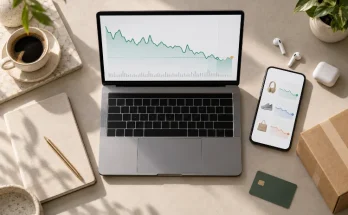
Imagine spending $2,500 on a brand-new laptop, only to discover that the exact same model is selling for $2,100 three weeks later. That $400 difference could have covered accessories, software subscriptions, or even a short weekend getaway.
Frustrating, right?
Unfortunately, this happens more often than shoppers would like. Prices for expensive products constantly fluctuate because of changing demand, inventory levels, seasonal promotions, competitor strategies, and broader economic conditions.
The good news is that modern shopping technology offers a smarter way to approach these decisions.
Predictive price analytics uses historical pricing information, statistical models, and artificial intelligence to estimate how product prices might change in the future.
Instead of relying entirely on intuition or waiting randomly for discounts, consumers can make purchasing decisions supported by meaningful data.
This approach becomes particularly valuable when shopping for expensive electronics, household appliances, furniture, vehicles, and other major investments.
Understanding how price forecasting works doesn’t mean you’ll always find the absolute lowest price. However, it can significantly improve your ability to recognize genuine value, avoid misleading promotions, and decide when buying actually makes financial sense.
1. Understanding Predictive Price Analytics for Major Purchases
Predictive price analytics is the process of examining pricing patterns and related market information to estimate potential future price movements.
Traditional price comparison tools focus on answering one straightforward question: Which retailer offers the lowest price right now?
Predictive systems attempt to answer something more interesting: Is today’s price attractive, or is there a reasonable chance of finding a better deal later?
That difference matters considerably when you’re preparing to spend hundreds or thousands of dollars.
How Price Tracking Differs From Price Prediction
Price tracking records how much a product costs over time. A tracking system might reveal that a television originally sold for $1,800, dropped to $1,500 during a promotion, and later returned to $1,650.
This information provides useful historical context, but it doesn’t necessarily explain what might happen next.
Predictive analysis goes further by examining recurring patterns, external conditions, and relationships between different variables.
For example, an algorithm might identify that televisions belonging to a particular product generation frequently experience discounts after successor models become available.
However, a prediction is still an estimate rather than a promise.
A manufacturer could unexpectedly reduce production, a retailer might run out of inventory, or a sudden increase in demand could push prices higher.
The real advantage comes from replacing impulsive decisions with evidence-based purchasing strategies.
Why High-Value Purchases Benefit the Most
Small pricing differences become financially meaningful when the original purchase is expensive.
A 10% discount on a $30 accessory saves just $3. The same percentage reduction on a $3,000 laptop creates $300 in savings.
That makes sophisticated shopping research especially worthwhile for high-ticket products.
Predictive analysis also helps consumers understand whether a discount is genuinely attractive compared with previous selling prices.
After all, a product advertised as 30% off isn’t necessarily a bargain if its current price remains higher than its usual market value.
2. What Data Powers Modern Price Prediction Systems?
Behind every useful pricing forecast is a collection of data points describing how a product behaves in the marketplace.
The quality of that information often matters more than the complexity of the algorithm analyzing it.
A sophisticated model built on incomplete or outdated information can produce less reliable results than a simpler system using consistent, relevant data.
Historical Prices and Seasonal Trends
Historical pricing records form the foundation of many forecasting systems.
Algorithms examine previous price increases, discount frequency, minimum selling prices, and the duration of promotional periods.
For instance, a historcial pricing dataset might show that a particular appliance category experiences recurring discounts around major shopping holidays.
The system can use that pattern to estimate whether waiting for a similar promotional period makes sense.
However, seasonal trends should always be interpreted carefully because previous discounts do not guarantee future offers.
Inventory, Demand, and Product Life Cycles
Retailers frequently adjust prices in response to inventory conditions.
When warehouses contain excess merchandise, sellers may introduce discounts to encourage faster sales. Conversely, limited stock combined with strong demand can reduce the likelihood of substantial price cuts.
Product life cycles provide another useful signal.
Premium smartphones, laptops, and televisions sometimes become cheaper as newer generations enter the market.
However, older models can also become difficult to find, causing certain configurations to maintain their prices or disappear from retail channels entirely.
Predictive models must therefore distinguish between ordinary depreciation and genuine supply shortages.
Competitor Prices and Economic Conditions
Online retailers operate in highly competitive environments where pricing changes can happen quickly.
One seller’s promotion may encourage competing businesses to adjust their offers, particularly when customers can compare identical products across several websites.
Economic conditions can also influence purchasing costs.
Exchange rates, import expenses, transportation charges, interest rates, and manufacturing costs may affect retail prices, although their impact differs across countries and industries.
Strong forecasting systems combine these signals rather than assuming that historical discounts alone determine future prices.
3. How AI and Machine Learning Forecast Future Prices
Artificial intelligence has expanded the possibilities of retail price analysis.
Instead of examining only straightforward seasonal averages, machine learning models can identify relationships between multiple factors that influence product pricing.
These systems often use methods associated with time-series forecasting, regression analysis, and pattern recognition.
Time-Series Forecasting and Statistical Models
Time-series forecasting examines observations recorded across different periods.
A relatively simple model might identify an overall downward price trend, recurring weekly promotions, and occasional large discounts.
More advanced approaches can incorporate additional variables, including stock levels, competitor activity, promotional calendars, and product launches.
Imagine a gaming laptop currently selling for $2,200.
A forecasting system might estimate that its price could move toward $2,000 over the next six weeks, based on available historical evidence and changing market conditions.
That forecast should not be interpreted as a guaranteed future transaction price.
It simply represents an estimate derived from the information available to the model.
Machine Learning and Probability-Based Predictions
Machine learning becomes particularly useful when pricing relationships are complicated.
Algorithms such as gradient-boosted decision trees can detect nonlinear relationships between pricing factors, while certain neural-network approaches can model longer-term sequences.
Still, more sophisticated technology does not automatically produce more reliable predictions.
The model must be tested against previously unseen observations, ideally using historical periods that simulate real purchasing decisions.
Amazon Web Services’ forecasting documentation explains methods for evaluating time-series forecasts through backtesting and accuracy metrics.
Although those techniques are frequently applied to demand forecasting, the underlying evaluation principles are relevant to retail price prediction.
One particularly useful concept is the prediction interval.
Instead of claiming a product will cost exactly $1,950 next month, a system might estimate a likely range between $1,850 and $2,100.
For shoppers, understanding that uncertainty is often more valuable than receiving a single confident-looking number.
Why Forecast Accuracy Matters
A prediciton that performs well during ordinary shopping periods might become unreliable during unusual market conditions.
Sudden tariffs, supply disruptions, unexpected product announcements, and aggressive competitor promotions can invalidate established patterns.
Reliable analytics tools should therefore communicate forecast uncertainty rather than presenting every estimate as a certainty.
Consumers should treat algorithmic recommendations as decision support, not instructions they must follow.
4. Where Predictive Analytics Delivers the Greatest Shopping Value
Different categories of expensive purchases have different pricing structures.
A strategy that works well for electronics may be much less useful when shopping for a used vehicle or custom furniture.
Understanding these differences helps consumers choose the most relevant information.
Premium Electronics and Computing Devices
Laptops, smartphones, monitors, and gaming equipment are strong candidates for price-history analysis.
These products usually have clearly identifiable model numbers, making comparisons between retailers relatively straightforward.
Technology products also experience frequent promotional activity and product-generation changes.
For example, a premium laptop might become more affordable during a retailer’s inventory-clearing campaign or following a newer model announcement.
Data from Adobe’s January 2026 holiday shopping report illustrates the importance of promotions.
During the November–December 2025 US holiday season, peak discounts reached 30.9% off listed prices for electronics and 23.4% for computers.
Those figures represent observed category-level promotional peaks, not guaranteed savings on every product.
Nevertheless, they demonstrate why monitoring retail pricing patterns can be worthwhile before a major technology purchase.
Household Appliances and Furniture
Refrigerators, washing machines, furniture sets, and other household products also offer opportunities for strategic buying.
Appliances may receive promotional discounts when retailers refresh product ranges or compete during major sales events.
Adobe’s same report recorded peak appliance discounts of 20.2% off listed prices during the 2025 US holiday shopping season.
Furniture pricing can be harder to evaluate because product specifications, materials, shipping arrangements, and retailer-exclusive designs vary considerably.
A seemingly identical sofa might contain different construction materials or warranty provisions.
Shoppers should therefore compare actual product specifications instead of treating visual similarity as proof of equivalent value.
Vehicles and Other Expensive Purchases
Vehicle pricing introduces another level of complexity.
Manufacturers’ incentives, dealer inventory, mileage, regional demand, financing conditions, and individual vehicle history can all influence transaction prices.
For new and used cars, market valuation tools can provide useful benchmarks.
Edmunds’ True Market Value methodology estimates average vehicle transaction prices using information that includes actual dealer transaction data.
These estimates help buyers evaluate whether an asking price appears reasonable.
However, they should not be confused with a guaranteed future price or a complete purchase cost.
For vehicles, predictive analytics works best when combined with local market research and careful negotiation.
5. Building a Smarter Purchase Timing Strategy
Knowing that prices fluctuate is useful, but turning that knowledge into a practical buying decision requires a structured approach.
The objective isn’t to monitor every small movement indefinitely.
It’s to establish a reasonable buying price, understand the potential benefit of waiting, and act when the conditions become attractive.
Establish a Realistic Reference Price
Start by identifying the exact product you want.
Record its model number, technical specifications, warranty coverage, and any important variations.
Next, examine available price history rather than relying exclusively on the manufacturer’s suggested retail price.
Google’s price insights documentation explains how supported product pages classify prices as low, typical, or high based on information collected from sellers.
This specific price-insights feature is documented for US shoppers.
A useful baseline should reflect actual market prices, not simply an advertised percentage discount.
If a laptop usually sells for around $1,800, a promotion reducing its price from a claimed $2,400 list price to $1,850 may not be particularly impressive.
Set a Target Price and Use Alerts
Once you’ve established a realistic reference point, choose a price that would justify purchasing immediately.
Suppose a television currently costs $1,500, while recent historical observations show regular selling prices between $1,300 and $1,600.
You might decide that $1,350 represents an attractive purchase threshold.
Price alerts reduce the need to manually check multiple websites every day.
According to Google Shopping’s price-tracking guide, supported users can monitor products and receive notifications when prices fall, including below selected target prices where available.
Google lists availability in the United States, Canada, Australia, Japan, and India, with some features varying by device and shopping interface.
Consumers elsewhere can investigate locally available retailer alerts or independent tracking services.
Compare the Expected Savings Against the Cost of Waiting
Consider an illustrative purchasing decision.
A laptop currently costs $2,400. Based on an assumed scenario analysis, there’s a 60% chance it will fall to $2,200 next month and a 40% chance it will rise to $2,500.
The probability-weighted expected future price would be:
(0.60 × $2,200) + (0.40 × $2,500) = $2,320
That suggests an expected saving of $80 from waiting, before accounting for other costs.
These probabilities are hypothetical, not real forecast outputs.
If postponing the purchase means losing $150 in productivity, waiting would probably be financially unattractive.
This is why effective purchasing decisions need both price expectations and personal circumstances.
A good price doesn’t automatically mean it’s the right time for every buyer.
6. Looking Beyond Discounts: Total Purchase Cost and Long-Term Value
One of the biggest mistakes in expensive shopping decisions is focusing entirely on the advertised purchase price.
A lower sticker price might conceal higher ownership expenses, additional fees, or unfavorable financing terms.
Predictive pricing tools become more useful when combined with a broader understanding of total cost.
Understanding the Total Cost of Ownership
The total cost of ownership includes the initial payment and the expenses associated with using and maintaining a product.
For a refrigerator, relevant costs may include electricity consumption, delivery, installation, repairs, and warranty coverage.
Consider two hypothetical refrigerators.
Model A costs $1,200 and consumes approximately $100 in electricity annually. Model B costs $1,350 but uses only $65 annually.
Over ten years, assuming constant energy expenses and excluding other costs, the totals would be:
- Model A: $1,200 + ($100 × 10) = $2,200
- Model B: $1,350 + ($65 × 10) = $2,000
Despite its higher purchase price, Model B becomes the cheaper long-term option under these assumptions.
Price forecasting alone would not reveal that advantage.
The same principle applies to vehicles, where financing, fuel, maintenance, insurance, and depreciation can dramatically affect long-term affordability.
The Consumer Financial Protection Bureau emphasizes the importance of considering additional costs beyond a vehicle’s advertised price.
Avoiding Misleading Discount Comparisons
Discount percentages are particularly easy to misunderstand.
Retailers may advertise reductions against suggested prices that rarely reflect what customers actually pay.
Some promotions also involve bundles, membership requirements, restricted payment methods, or additional shipping charges.
A proper comparision should examine the final payable amount for equivalent products under equivalent conditions.
That means checking sales taxes, delivery, installation, service fees, and warranty differences where applicable.
A $200 discount that requires $150 in extra charges provides far less value than the headline suggests.
When evaluating major purchases, the most useful metric is often the final cost relative to the product’s practical value.
7. The Limitations, Privacy Risks, and Future of Price Analytics
Predictive analytics can improve shopping decisions, but even advanced systems have important limitations.
One major challenge is incomplete data.
A tracking service may monitor only selected retailers, overlook exclusive promotions, or fail to capture prices available through membership programs.
Another difficulty involves sudden changes in market conditions.
Why Algorithms Sometimes Get Prices Wrong
Forecasting systems are generally better at recognizing recurring patterns than anticipating completely unexpected events.
An abrupt shortage, regulatory change, or unusual demand surge can make previously reliable assumptions obsolete.
Models can also misunderstand temporary promotional outliers.
For instance, a one-day clearance sale might create an exceptionally low historical price that shoppers are unlikely to encounter again.
Without adequate context, the algorithm might treat that unusual event as an achievable future discount.
Product availabilty also matters.
Waiting for a predicted price reduction isn’t helpful if the desired model disappears from the market before the discount arrives.
Consumers should therefore consider stock risk, purchase deadlines, and acceptable alternatives alongside price forecasts.
Personal Data and Algorithmic Pricing
The growing use of consumer data raises another important issue.
Some retailers and pricing intermediaries use information about browsing behavior, location, shopping activity, and customer characteristics to influence personalized offers or product recommendations.
In January 2025, the US Federal Trade Commission published initial findings examining surveillance pricing practices.
The investigation identified how intermediaries could use detailed personal information to support individualized pricing and promotional strategies.
Those findings should not be interpreted as proof that every retailer charges individual shoppers different prices.
They do, however, highlight why consumers should understand how their information is collected and used.
When choosing price-tracking services, review privacy policies, app permissions, and the information required to create an account.
The Future of AI-Powered Purchase Decisions
Future shopping systems may increasingly combine pricing forecasts with product recommendations, inventory signals, and automated purchasing assistance.
Instead of simply showing that a product has become cheaper, an AI assistant could potentially compare alternatives, evaluate ownership costs, and explain the trade-offs between purchasing now and waiting.
More sophisticated systems may also account for individual budgets, preferred specifications, and purchasing deadlines.
However, transparency will remain important.
A useful shopping assistant should explain why it expects a price movement, acknowledge uncertainty, and distinguish genuine savings from marketing claims.
Ultimately, better purchasing decisions will depend on how effectively technology supports human judgment rather than attempting to replace it.
Predictive price analytics gives consumers a more informed way to approach expensive purchases. By combining historical prices, market signals, forecasting models, and practical financial considerations, shoppers can better understand when a deal represents genuine value.
The biggest advantage isn’t predicting every price movement perfectly. It’s reducing uncertainty, avoiding impulsive purchases, and recognizing opportunities that might otherwise go unnoticed.
Remember that forecast accuracy, product availability, ownership costs, and personal timing are just as important as advertised discounts.
Before making your next major purchase, research the product’s price history, establish a realistic target, compare competing offers, and evaluate whether waiting actually makes financial sense.
Start tracking your next high-value purchase today, and turn smarter price insights into more confident buying decisions.